How do you consider your bones? What are your bones to you?
What is the first image that comes to mind when you think of ‘bone’ – is it the bony remnants of a dead body – i.e. the bone that resides separate to its origin, outside of the body in which it grew?
Is it the white mineral hard shell that hides an inner world that is rarely contemplated?
The inner structure of the body that the soft blood-full flesh rests upon, joins or wraps around – the bones are part of the ‘connective tissue matrix’ that emerges from one embryological cellular layer. Where the bones emerge close to the surface, we see the white smooth superficial ‘skin’ of the bone under our tactile sensory membrane – our skin, like the ’white’ knuckles in a fist pump or of the toes and the arch of the foot in bare foot walking.
These bones we sense, feel and move are able to regenerate, heal and replace themselves – they are made of living cells that multiply to grow or regenerate the bone tissue. The cells provide the body of the bone and the space for the mineralisation process that builds the density and compactness of the outer layers and the more spacious mesh or trabeculae within. Your bone is strong and elastic, it bends under force, and it breaks.
Did you ever break a bone and have to wait for it to heal? Do you sense and feel the vulnerability of bone and so of yourself? Does the skeletal system hold any story or mystery to you?
A brief bone story; I recall dancing ballet and feeling my hip joint click when I had to swing the leg out to side over 90 degrees. I thought I was an ‘odd bod’ as no one else voiced this as an issue. It was years later when I studied the rotational space of the hip joint that I noticed the natural impingement of the two bones at the joint. Then I could move with ease; this ‘issue’ fell into the background, into the space of acceptance of the natural limitations of the mechanical nature of the bones and the articular surfaces of the joints due to gravity and power of the muscles that move them.
In embodying the skeletal system I found a space free of judgement, I found the sense of trust in the inter-systemic nature of bodily life.
Each bone has a pair on the other side of the mid line, or, as with the spinal bones, the vertebrae, they form a motile ‘column’, but have symmetrical sides, with processes for muscles to attach to, or at the thoracic spine, for the ribs. Each bone functions as a part and as a part of a whole system – moving in relation to all the other bones, shaping the body, providing stability and enabling mobility – if our life style is conducive to this freedom.
This relationship between structure, movement and our experience of the body is part of the experiential anatomy explored through Body-Mind Centering®.
Each bone has a distinct shape – even though my bones are different to yours the basic shape and form will be the same – the long bones of the limbs, the flat bones of the sternum and shoulder blade, the skull bones grow around the corresponding brain areas that the bones then protect.
The white of the bone is unmistakable, the smooth strong outer membrane can be touched and enjoys being touched, differentiated from the fleshy belly of a neighbouring muscle. The nerves and blood vessels establish the two-way exchange of sensory information and nutrients, so we ‘feel’ in our bones, we tremble with our ‘bag of bones’, we generate our blood cells within the soft marrow of our bones – and that’s another story…
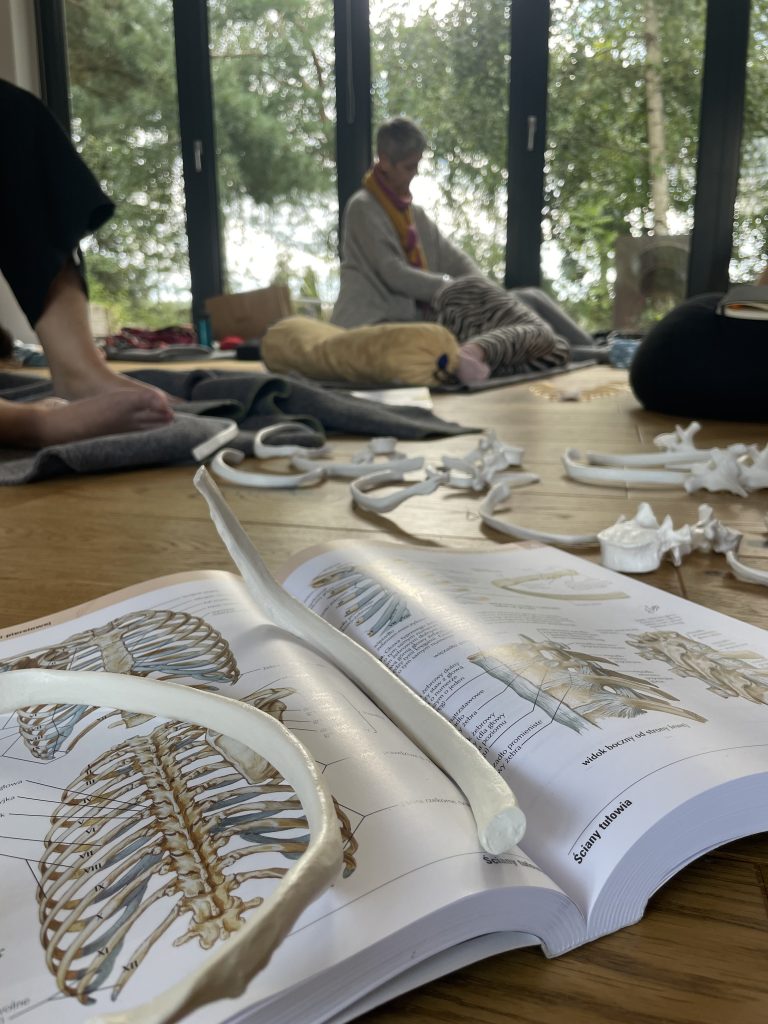
Exploring the bones in this experiential way forms part of the wider study of body systems within the Somatic Movement Education (SME) programme, where movement, touch and embodied anatomy are brought together.
For those wishing to explore these ideas directly through movement and touch, the Skeletal System course looks specifically at the relationships between bones and joints, skeletal alignment and the principles that support ease of movement.