The Infant Developmental Movement Education (IDME) programme offers a unique opportunity to explore the foundations of human movement, perception and relationship through the study of infant development.
The IDME programme is a more condensed study track than the Somatic Movement Education (SME) programme, although it can still encompass two years of study, depending on how quickly the four developmental prerequisite courses are completed. These courses are shared with the SME programme. Some students choose IDME, while others complete SME and add the IDME 1 and 2 courses to gain both qualifications.
Understanding Human Development Through Infant Movement
Many students are attracted to Infant Developmental Movement Education even though they may not work with infants in the future. The uniqueness of this work enables us to better understand the individuality of each human being and the importance of attuned relationships at every stage of life.
Bonnie Bainbridge Cohen, founder of Body-Mind Centering® (BMC®) training, speaks about the ‘gifts’ that each child brings to us and to the world.
Each infant is an individual, a little person who gestures who they are through bodily responses before they find their voice and open their senses to widening realms of relating.
Meeting the Whole Child: Infant Visits During IDME Training
Infant visitors are invited into our training sessions by students, faculty members or IDME graduates. Within the training, we follow five developmental stages:
- Neonate (newborn)
- 0–3 months
- 4–6 months
- 7–9 months
- 10–12 months
Each stage represents a phase within the usual range of human developmental progression. Regardless of age or developmental expectations, however, we meet the infant where they are. We meet the whole child.
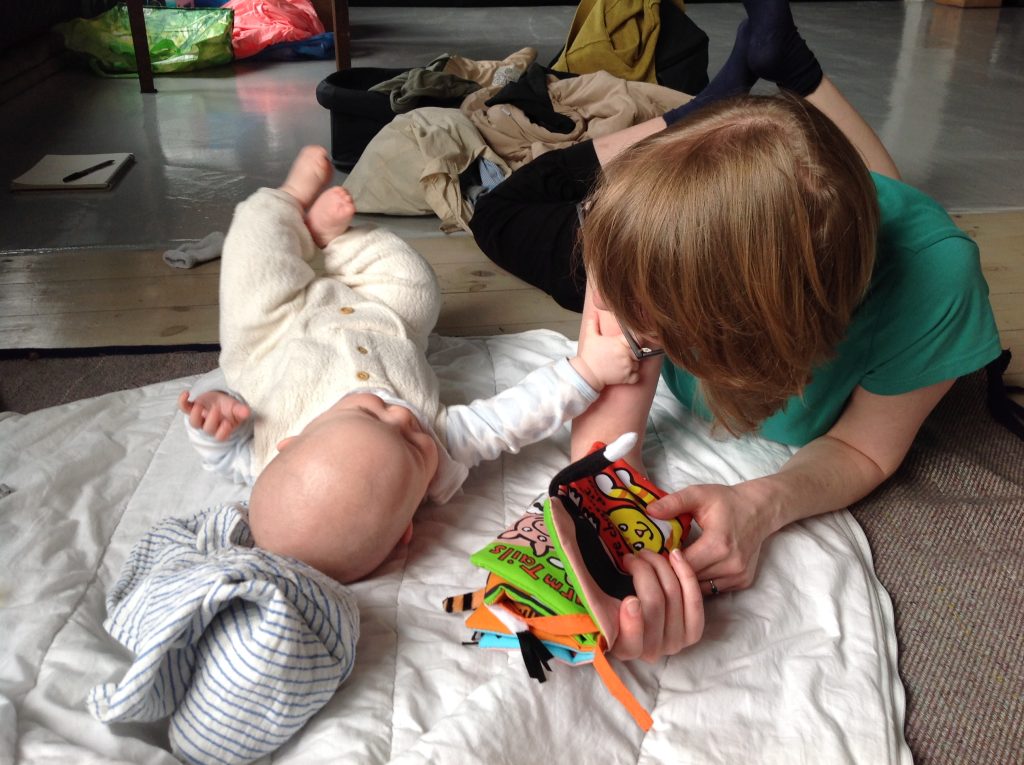
When the infant arrives at the studio, we settle onto the floor with a quilt, cushions, a gym ball and toys appropriate to their age and interests.
Before the visit, we communicate with the mother, father, family member or caregiver to understand what aspects of their story they feel comfortable sharing with the group and what may be better held within a private session.
All interactions take place with the caregiver’s consent. We meet, share ideas and ask questions, seeking ways to create a responsive and supportive relational space.
Exploring Our Own Development Through Movement
Throughout the IDME programme, we revisit our own developmental movement experiences. We do so again when meeting infants, exploring on our bellies and establishing a sense of their relational field.
We find ways to connect through interaction with objects, witnessing the infant’s responses. Something as simple as placing a toy in the palm of a hand can reveal a rich movement experience.
We witness the delicate transitions between different states of consciousness. At times, the infant may be bonded and attuned to themselves and to the earth beneath them, finding calm and recuperation. At other times, they may become activated in response to sensory stimuli.
We adjust our own physiological tone to meet the infant’s and notice when a supporting hand might assist an emerging transition or movement pathway. These possibilities can also be explored with the caregiver.
We may adjust our vocal tone, inviting sound and the experience of being heard. Comfort and ease create a foundation from which the infant can follow their curiosity.
Reflexes, Sensory Awareness and Early Learning
In infants, we witness how primary reflexive responses support their ability to move towards or away from the world.
These initially unconscious movement responses demonstrate how innate intelligence becomes available for learning through relationship.
Infant consciousness changes with each encounter between the body and its surroundings. Touch may initiate a movement response: to stay, explore, connect and converse, or to withdraw towards the self and seek relationship elsewhere or through other senses.
The First Three Months: Awakening to the Senses
The first trimester of life is full of moments of awakening.
There are the smells and tastes of milk, vibrations from sounds in the surrounding environment, the tone of a familiar voice and the infant’s own internal sounds.
Light illuminating the environment invites curiosity, exploration and experience.
The relationship between self and world becomes a realm of discovery and learning. The quality and intensity of sensory stimulation are therefore important, particularly in avoiding overwhelm.
The Role of Touch, Movement and the Nervous System
As IDME practitioners and caregivers, we explore how touch and other sensory information travel through the nervous system, contributing to muscular responses and the developing coordination of movement.
We learn about the roles of the spinal cord, brainstem and cerebellum in supporting early movement organisation.
Movement and touch also contribute to proprioception: our sense of where the body is in space and how its different parts relate to one another.
Each micro-movement brings awareness to a part within the whole being. Over time, different body segments become more differentiated, contributing to increasingly complex experiences of movement, awareness and relationship.
These explorations are central to the developmental movement studies shared by IDME and Somatic Movement Education. For a broader perspective, read our article on Body-Mind Centering®, embodied self-inquiry and human connection.
Gravity, Body Tone and Emerging Movement Pathways
The infant body has a fluid quality of tone in the foreground. Soft internal tissues and limbs yield into gravity as the body surface meets the surface of the earth.
As tone increases along the underside of the body, the limbs begin to unfold and find their connection towards the navel. The head lifts and turns, perhaps towards the earth or to one side.
We explore these micro-movements together, sensing the pathways and connections between each tissue and the whole.
We encounter the bones as structures supporting the organ cavities and limbs, and the organs as an internal support for the motility of the whole body.
Through this embodied exploration, we can meet the infant in the delicate simplicity of their realm of being.
We begin to sense and feel the patterns and pathways they have already discovered, alongside those that are still emerging.
Learning Through Relationship Rather Than Assessment
A central principle of Infant Developmental Movement Education is learning through interaction and gentle observation rather than approaching the infant solely through objective assessment.
Our intention is to support the family as the core relational environment in which the infant grows and develops.
We learn to notice, respond, adapt and accompany the infant’s discoveries without imposing a predetermined outcome.
In this way, the work is not only about understanding infants. It also offers a foundation for working with people of different ages and abilities.
If we can learn to work with infants through sensitivity, responsiveness and relationship, we develop a basis for meeting people throughout life.
Explore Infant Developmental Movement Education Training
For those interested in deepening their understanding of infant development, movement, touch and relational learning, Embody Move offers training in Infant Developmental Movement Education through the School for Body-Mind Centering®.
The programme combines experiential developmental movement study with practical learning alongside infants and their caregivers.
Explore the IDME programme, prerequisites and upcoming courses.
If you would like to discuss the training or find out whether it is appropriate for your personal or professional development, please contact Embody Move.